

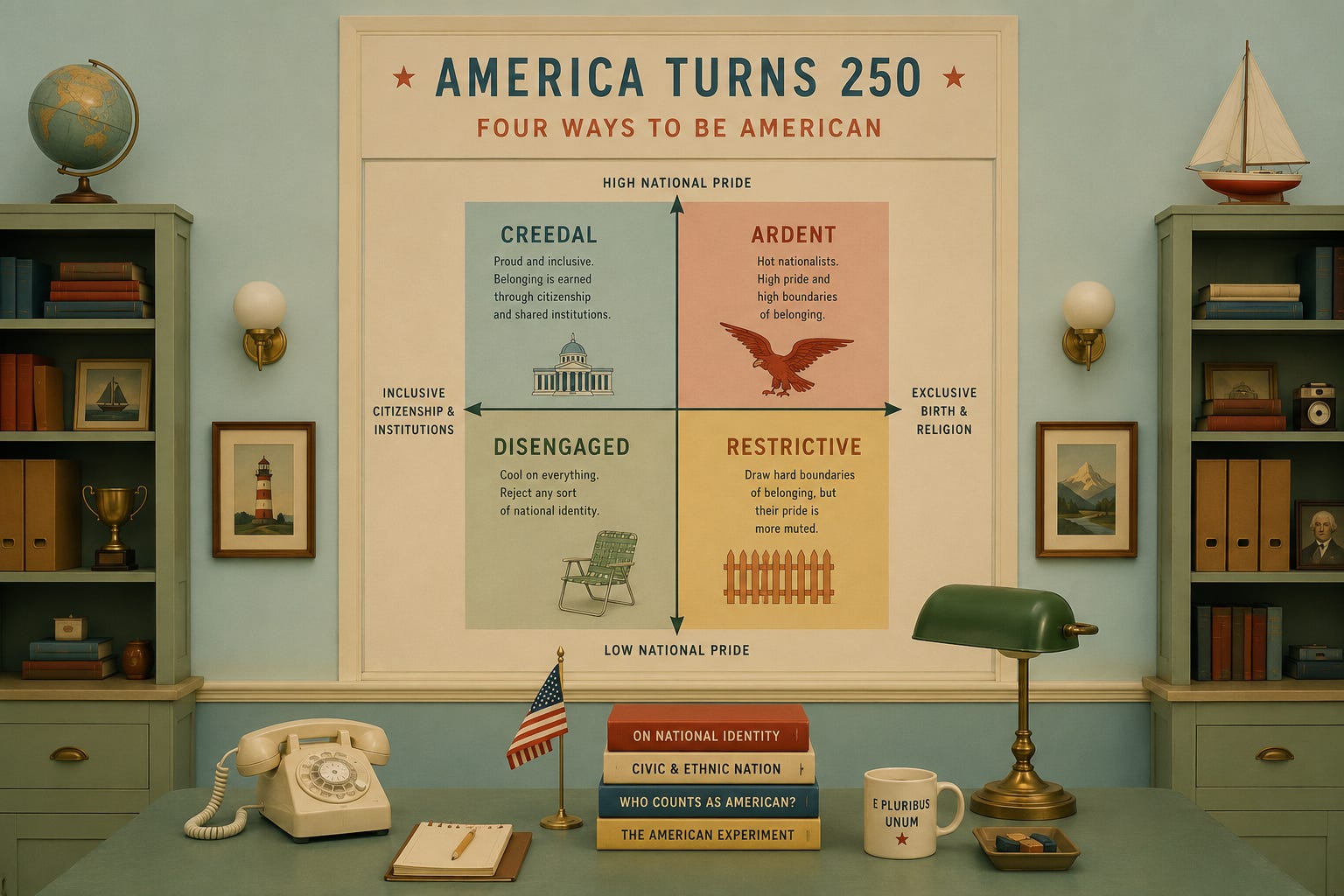
Note: Data and replication code for the analysis provided here are available on GitHub.
The United States turns 250 this year, and the old argument over what it means to be American remains as intense as ever. What better moment than now to engage in that age-old debate of what it means to be an American? Flatten by media coverage, the debate usually gets cast as two options. Either the country is a creed, a set of ideas anyone can sign up to, or it is a heritage, as a matter of belonging that you inherit by birth and/or blood.
That two-sided framing is not merely an artifact of punditry. It dates back at least to the historian Hans Kohn, who, in 1944, distinguished between civic and ethnic nationalism. Civic nationalism defines the nation in political terms, as a community of citizens bound by shared institutions and ideals. Ethnic nationalism defines it in cultural and genealogical terms, as a people united by common ancestry, language, or heritage. At its core, Kohn's distinction concerned how people answered a fundamental question: who belongs to the “circle of we"? To a large degree, this civic-ethnic distinction has organized the study of nationalism ever since. Scholars have, of course, challenged how clean the divide really is. As Anthony Smith argued, even civic nations draw on ethnic myths and symbols.1
As public opinion surveys became a cheaper and more reliable way to measure public opinion, political scientists and sociologists began asking people directly who belongs to the nation and how they relate to it, rather than inferring those views from elite rhetoric. Deborah Schildkraut’s Americanism in the Twenty-First Century and Elizabeth Theiss-Morse’s Who Counts as an American? both show that Americans’ views are more varied than a simple creed-or-heritage divide suggests.2
When Americans are asked directly, they do not divide neatly into two camps. Using a method that identifies recurring patterns across attitudes toward national belonging and national pride, Bart Bonikowski and Paul DiMaggio distinguish four dispositions. Their typology, however, was developed from a 2004 survey and only later compared with data from 1996 and 2012. The question is whether those same four types still structure American national identity today.
I replicated their approach using the International Social Survey Programme’s (ISSP) National Identity module, which asked the same battery of questions in 1995, 2003, 2013, and 2023. I find, again, the same four identiy types. Americans do not sort into two competing visions of the nation, but four. What has changed over the past three decades is the relative size of those groups. One has remained remarkably stable, while the others have risen and fallen.
Two questions, four Americas
The types follow from two basic categories of questions. First, who counts as truly American? Is it about being born here and being Christian, or about citizenship and respecting the country's institutions? Second, how warm you feel about America. How proud are you of the country? Crossing these two dimensions gives you four identity types.
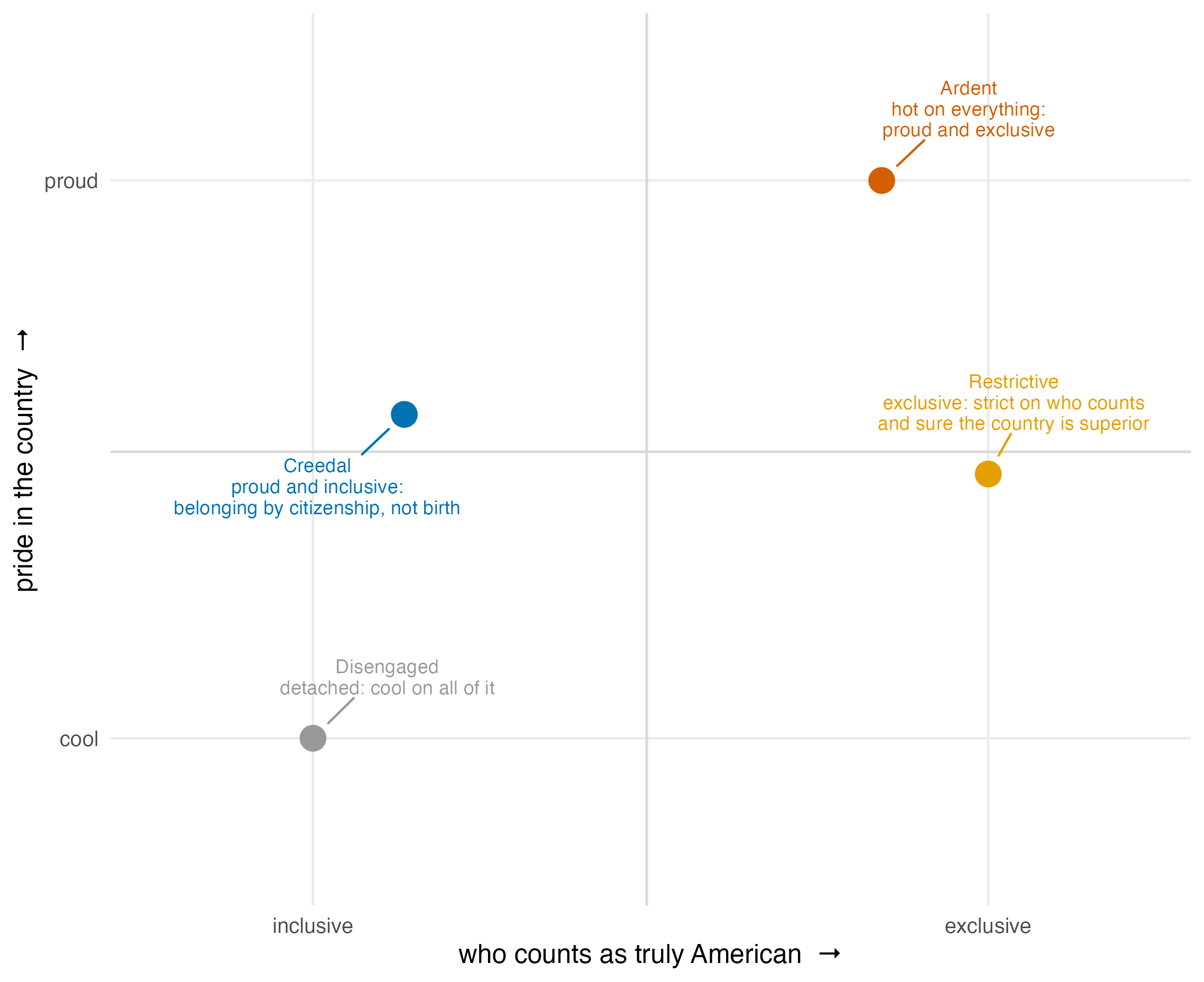
The horizontal axis captures who counts as truly American, from inclusive (citizenship and shared institutions) to exclusive (birth and religion). The vertical axis captures national pride. The types and their attitudes are then as follows:
Ardent: “hot” nationalists, scoring high on everything. They want high boundaries for belonging and are proud across the board.
Restrictive: people who also draw distinctive boundaries of belonging and are sure the country is superior to others, but their pride in its actual achievements runs cooler than ardent nationalists.
Creedal: those who are proud and inclusive. They anchor belonging in citizenship and institutions rather than birth or ethnicity/religion, and they are less likely than ardent or restrictive nationalists to say the country is better than others.
Disengaged: those “cool” on all of it, rejecting or downplaying any sort of national identification.
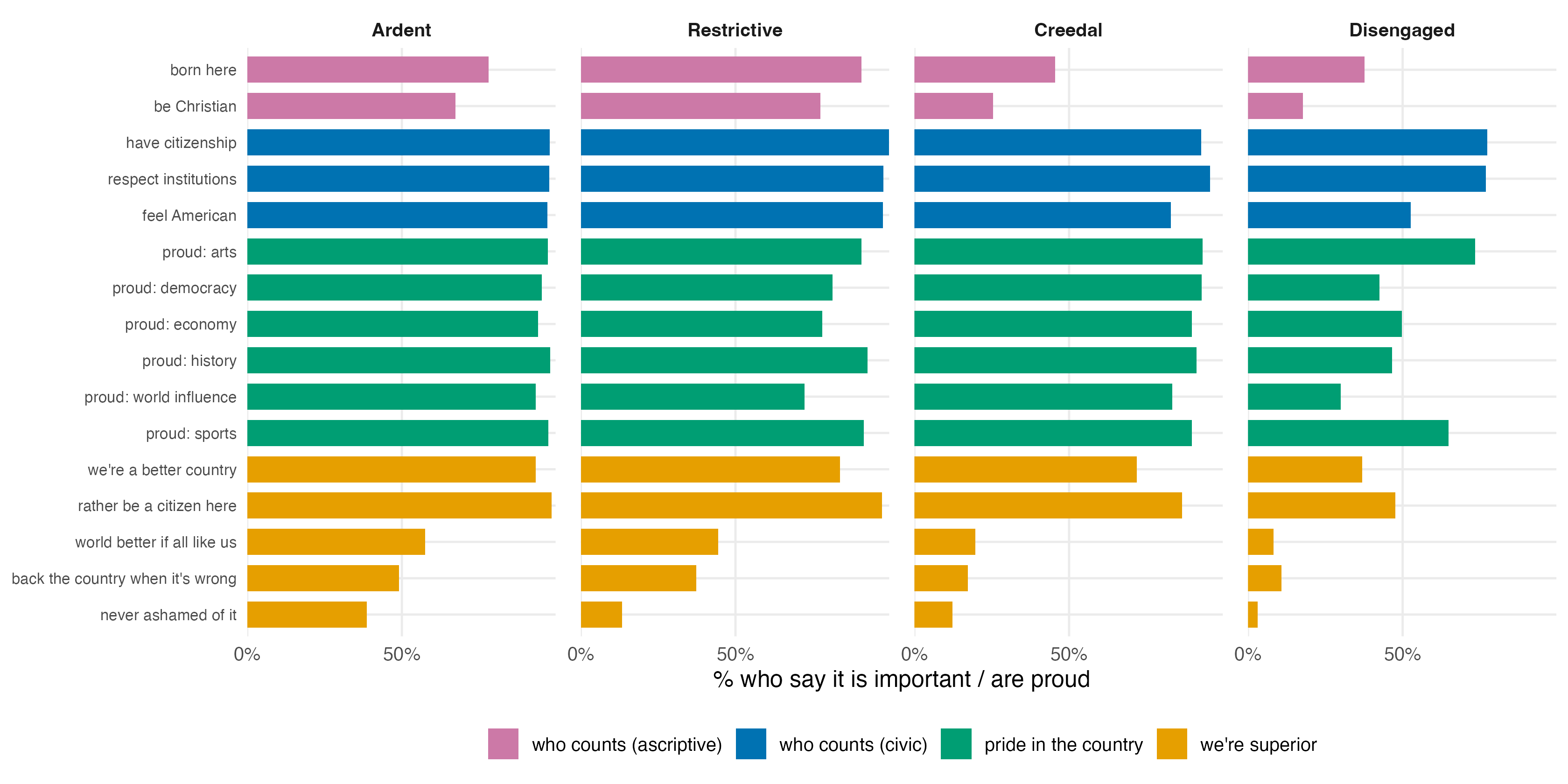
You can see each type's profile in the survey responses. The clearest divide is not national pride, which most engaged Americans share, but the boundaries of belonging. The ardent and restrictive types are much more likely to say that being Christian is part of being truly American and that the United States is superior to other countries. Creedal Americans reject both of these items as conditions for national membership. They are low on the ascriptive criteria (born here, be Christian) and on superiority, but high on the civic criteria (citizenship, respecting institutions) and moderately proud, the signature of an inclusive-but-attached patriotism. The data presented so far already complicates the creedal-versus-heritage framing.
How the types are measured
Since this Substack is meant to be somewhat technical, a word on how the types are constructed. The data come from the ISSP National Identity module, which fielded comparable nationally representative U.S. surveys in 1995, 2003, 2013, and 2023. I use the sixteen items included in all four waves.
As the figure above shows, the questions fall into three broad domains: who counts as truly American, how proud respondents are of different aspects of the country, and whether they express a sense of national superiority or unconditional loyalty. The first domain distinguishes civic criteria, such as citizenship and respect for institutions, from ascriptive ones, such as birthplace and Christianity. The first eleven items use four-point response scales; the remaining five use five-point agree-disagree scales.
The identity types are derived from latent class analysis. The method treats the population as a mixture of unobserved groups, each defined by a distinct pattern of responses. It estimates both the size of each group and the probability that each respondent belongs to it. Unlike factor analysis, a commonly used alternative in the study of national identity, which places respondents on one or more continuous dimensions, latent class analysis identifies qualitatively distinct types of people whose responses cluster together. That makes it well suited to studying national identity when the question is not how much nationalism people express, but how they combine different ideas about belonging and national pride. Bonikowski and DiMaggio adopted this approach, which is why "creedal" here refers to a type of respondent rather than a high score on, say, a creedal scale.
I estimate latent class models with one to six classes and selected the four-class solution based on model fit and interpretability. The classes are well separated, and the same four-type structure appears in all four survey waves.3
What changed
The next question is how these four conceptions of the nation have changed over time. Below is the proportions belonging to one of the four over the last thirty years. What do we see?
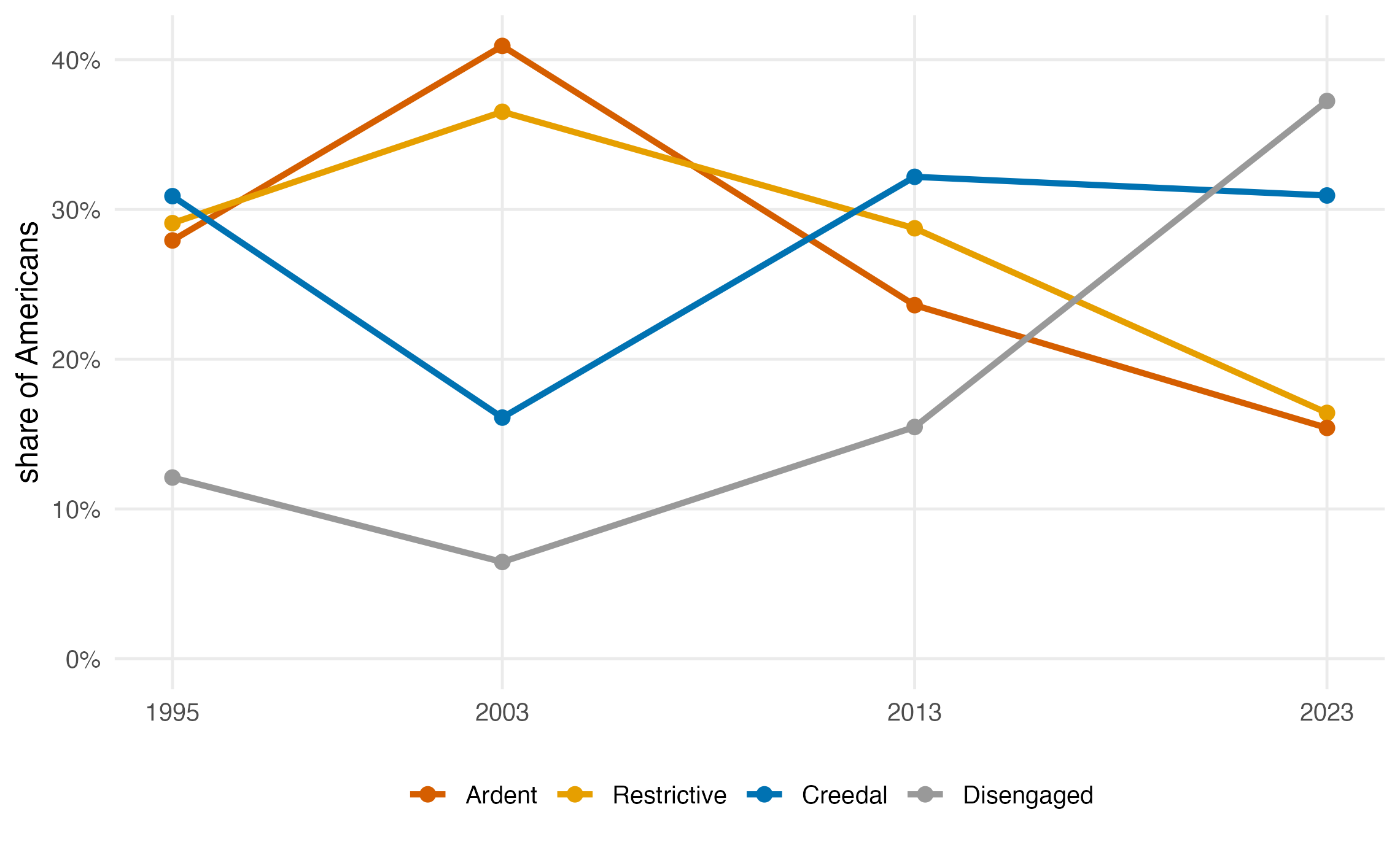
Two things stand out. First, the two hot types have receded. The September 11 terrorist attacks produced a sharp but temporary surge in more exclusionary forms of nationalism. The ardent type reached its peak in 2003 before steadily declining, while the restrictive type has fallen below its pre-9/11 level. Second, the creedal type experienced the inverse of that surge. Its share fell sharply in 2003 but returned to its long-run level of roughly one-third of Americans by 2013, where it has remained since. Across three of the four survey waves, the inclusive conception of the nation is the modal form of American nationalism.
Perhaps most striking is the growth of the disengaged. In 1995, they accounted for about one in eight Americans. By 2023, they had become the largest of the four groups, comprising more than one-third of the population. Because these are repeated cross-sectional surveys rather than panel data, we cannot conclude that individuals moved from the ardent or restrictive types into disengagement. But the aggregate pattern is consistent with exactly that possibility.
This finding should hold our attention. In 2023, the most common way of relating to the nation is detachment. It is hard not to make this connection to a broader retreat from shared life and experiences. Interpersonal trust has fallen, while community and religious membership has thinned out. Isolation has risen to the point that the Surgeon General has called it an epidemic. The problem is less that Americans hate one another's idea of the country than that a growing number are opting out of having one at all.
Politically, the next obvious question is whether this shift has unfolded similarly between left/right partisans. Looking separately at Democrats and Republicans show both encouraging similarities and notable differences.
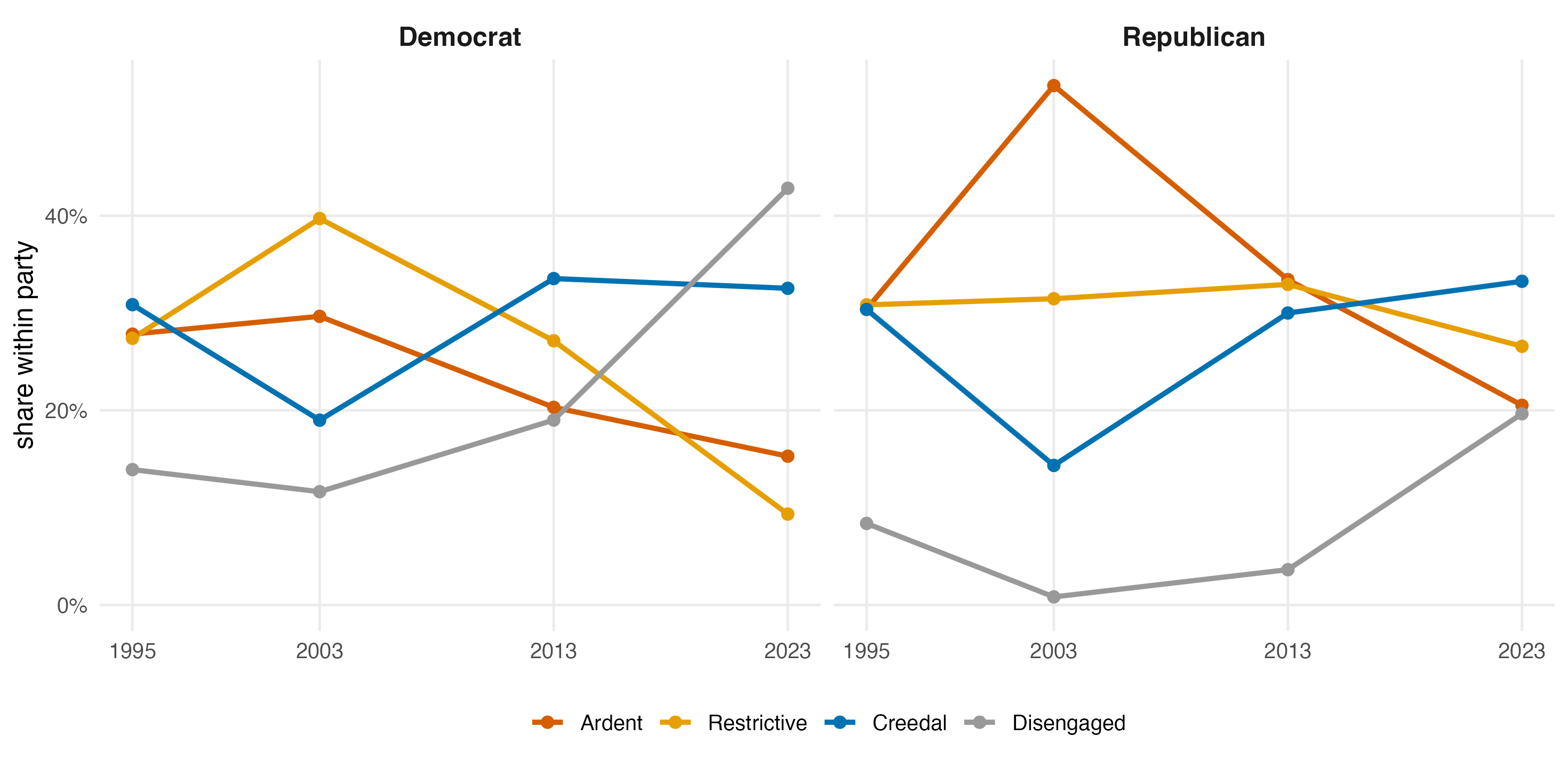
The most striking finding is the stability of the creedal type across the partisan divide. Throughout the past three decades, roughly one-third of both Democrats and Republicans have held an inclusive but proud conception of the nation.
Where the parties differ is in the trajectory of the other three types. Among Democrats, the hot and boundary-drawing types declined, with most of that shift moving toward disengagement, which now accounts for more than four in ten Democrats.
Among Republicans, the restrictive type remained relatively stable, although it now appears to be declining as well. Instead, the defining change over the past three decades was the sharp post-9/11 surge in ardent nationalism, followed by its steady decline. Disengaged Republicans also became more common, although they remain much less prevalent than among Democrats.
The case for liberal nationalism
The creedal conception of the nation has proven more durable than the others. For those who see liberal nationalism as the most desirable basis for democratic politics, that is encouraging news. Creedal Americans define national belonging in terms of citizenship and shared institutions rather than ancestry, while expressing pride in their country without believing it is superior to others. This is what political theorists call liberal nationalism. It is, among self-identifying nationalists, a normatively desirable form of thinking about community in the nation-state era.
The central claim of liberal nationalism is straightforward. A shared civic identity can sustain liberal institutions by encouraging strangers to see one another as members of the same political community. Rather than defining the nation by ethnicity or religion, it defines membership through citizenship and shared democratic institutions.
The distinction is not merely theoretical. It also lies at the heart of one of the country’s most consequential constitutional debates: birthright citizenship. Creedal Americans place relatively little weight on being born in the United States as a condition of being “truly American,” but they overwhelmingly regard citizenship as essential. The logic of the creedal conception therefore points toward jus soli — citizenship, rather than ancestry, is the basis of national belonging. The Supreme Court’s recent decision In Trump v. Barbara (2026), reaffirming birthright citizenship under the Fourteenth Amendment, reflects this civic understanding of national membership.4
In recent years, a growing number of scholars have argued that liberals should reclaim this inclusive form of nationalism rather than cede the idea of the nation to more exclusionary visions. Writers making that case for America, from Noah Smith to Alexander Kustov and others, argue that the strongest foundation for national identity is one rooted in citizenship rather than ancestry, open to newcomers, and confident enough in its ideals to welcome them as fellow citizens. Attempts to bypass national identity altogether, whether through cosmopolitanism or other forms of supra- or non-national identification, they argue, simply leave the language of nationhood to the demagogues.
My findings suggest that this civic conception of the nation is more than a normative ideal. While ardent, restrictive, and disengaged forms of national identity have expanded and contracted over the past three decades, the creedal type has remained remarkably stable, accounting for roughly one-third of Americans in every survey. Nor is that durability merely an American curiosity. In my comparative study of twenty-nine countries, the United States emerges as the clearest example of civic nationalism: the country where commitment to democratic rights most strongly constrains hostility toward outsiders.5
The road ahead
So the mood on America's 250th should be one of cautious optimism. The meaning of the American nation remains unsettled. The “bets still on the table”. The civic conception of the country has endured, exclusionary nationalism has not become dominant, but a growing share of Americans remains disengaged rather than committed to either vision.
There is, to be sure, a real loss of attachment. But that also leaves space for persuasion. As Ross Douthat argues, America’s enduring strength is its capacity to continually renew itself. This is a contested nation, but diversity is somethig most Americans think makes the country stronger, anyway.
The central challenge, then, is not simply to contain exclusionary nationalism, which is always going to exist in some form or another. It is to build a more compelling alternative. The evidence suggests that the most durable conception of the American nation is also the most small-l liberal. It is the one that grounds belonging in citizenship, shared institutions, and common political commitments rather than ascriptive characteristics. For advocates of liberal nationalism, the task is therefore not only to oppose exclusion, but to persuade the growing number of disengaged Americans, especially on the left, that the American experiment is still a project worth identifying with and investing in.
Hans Kohn, The Idea of Nationalism: A Study in Its Origins and Background (1944), is the source of the civic-versus-ethnic distinction. Anthony Smith spent much of his career complicating it, arguing that civic nations carry their own ethnic and symbolic content. Rogers Brubaker’s Citizenship and Nationhood in France and Germany (1992) shows the distinction operating as law, not just rhetoric. Even Samuel Huntington, in Who Are We? (2004), pushed against a purely creedal reading of American identity, though from the other direction. He argued the creed itself grew out of, and depends on, an Anglo-Protestant culture rather than standing free of one. Rogers Smith’s Civic Ideals (1997) is the fullest brief for a third view, that American political culture has always uncomfortably and contentiously bound liberal, republican, and ascriptive traditions together rather than resting on the creed alone.
Both books draw on original national surveys, not just theory. Jack Citrin’s decades of work on American identity, much of it with co-authors including Donald Green and David Sears, can be read as the earlier generation of this empirical tradition.
The four-type structure is imposed as a modeling constraint. I estimate a multi-group latent class model that holds the class-specific response profiles constant across waves while allowing only class proportions to vary. I compared this specification with an alternative that allowed the class-specific response profiles to vary across waves. The constrained model was preferred because it had a lower Bayesian Information Criterion (BIC), a standard measure that balances model fit against unnecessary complexity. So, the class definitions are estimated jointly from all four waves. Holding the measurement model fixed ensures that changes in class proportions reflect changes in the prevalence of the same latent types over time. Estimating the model separately for each wave would redefine the classes in each year, making longitudinal comparisons of the identity groups confusing.
Citizenship is one of the few criteria endorsed across all four types: 93 percent of creedal respondents and essentially all restrictive respondents say it is important to being truly American. Birthplace is far more divisive. Between 78 and 91 percent of ardent and restrictive respondents say one must be born in the United States, compared with 45 percent of the creedal type. Pew likewise finds declining support for birthplace as a criterion of American identity, especially among Democrats. Notably, roughly two-thirds of Americans support birthright citizenship, although support drops when surveys ask specifically about children born to parents who are in the country unlawfully.
I show across 29 countries that democratic commitment restrains the exclusionary face of nationalism mainly where nationhood is imagined in civic rather than ethnic terms. The US is the civic nation exemplar, with the strongest such restraint of any country in the sample. See: Steven Denney, Democracy and Nationalism, Reconsidered (June 09, 2026). Available at SSRN: https://ssrn.com/abstract=6904542.