

Optical character recognition (OCR) is a method by which an image of a page is converted to text, which can then be searched, counted and analyzed. For much of its history, OCR operated in a serial manner. Image cleanup, text block localization, line segmentation, and character recognition for each line, using a model trained for the language or script, were separate stages performed by programs in a pipeline. Tesseract, the open-source standard, was developed by Hewlett-Packard from 1985 to 1994 and its source code open-sourced in 2005. Google took over development from there. Version 4 (2018) began to employ a neural network for character recognition, but the network still processes line-by-line.
Programs of this sort do a good job of reading clean, modern print set in the Latin alphabet. The further from that configuration, the worse their performance. If, for instance, the program misjudges the layout on a page typeset in vertical columns, then all subsequent steps are operating on the wrong strips of the page. A model trained on one script will have a difficult time with a given page that contains a mixture of two, e.g. Korean text and Chinese characters (hanja). Good performance on such pages typically meant the model was either trained or tuned on the same sort of data. Those with the means could commission such work. The National Diet Library of Japan had their scans read (in 2021–22) by an OCR tuned on the same scans by LINE. Others, i.e., most researchers, could not.
However, the introduction of vision-language models (VLMs) has changed the game. A VLM is essentially a language model that is also trained on images, and this is the mechanism that allows a chatbot to describe an image you upload. For OCR, you give the model the image of a page and a prompt that asks for the text on it. The model will recognize the layout of the page (how it should be read) as well as what the characters on the page are, though some systems first split the page into regions in a separate step. The model can read multiple languages and scripts, and it can use the other words on the page to help it read difficult characters. The general models can also follow instructions such as “keep the captions”, “don’t read the page headers”, and “keep the old spellings”.
The second shift is that many of these models have weights that you can download, so you can run the models yourself. Every month or two there’s a new VLM, generally in one of two categories: general text and image VLMs (e.g., Qwen, Gemma) or smaller models designed to read documents (e.g., OvisOCR3, PaddleOCR-VL). For this post I’ve run a benchmark of 14 different models (each run on one GPU), all released in July 2025 or later (11 of them this year). If you work with Korean, Chinese, or Japanese print and have scans of it (a vertically typeset book in Japanese, a Korean textbook mixing hanja and hangul characters), you can have that text in a machine-readable form without having to train a model yourself.
Why not rely on the frontier models provided by Google, OpenAI, or Anthropic? Despite these models being the best of the best, there are plenty of reasons to use open-weight ones. First, some scans cannot be submitted to a third-party company due to their personal data content, or because of a library agreement. Second, hosted models are updated and removed, but the downloaded model weights remain unchanged, thus allowing the same run to be repeated years down the line (important for obliging FAIR principles). Third, frontier models can be extremely expensive (and total overkill), since you are paying for the frontier. Fourth, when you have your own copy, you control what image resolution you use, where to set the limit on the output and any second attempts, and you can fine-tune the model on your own data. Fifth, the provider can refuse to generate an output (for instance, Google's Gemini can stop a response it flags as recitation). For a few dozen pages you are free to share, a hosted frontier model might still be easier to use, and might actually be better at reading very challenging pages. I have not attempted any sort of comparison between hosted frontier models and the open-weight models benchmarked here.
VLMs bring problems of their own. When an older engine fails, the output usually looks wrong. A VLM can write fluent text that is not on the page, or repeat itself until it is cut off. One further challenge is model selection, as the most widely-used leaderboards assess predominantly Chinese and English-language documents. Thus I constructed a benchmark for what I actually work with, old print in Korean, Japanese and Chinese (with English as the comparison). This is my initial report, and I intend to continue updating it with new models as they are produced.
What I did
I took 1,169 pages (1,109 of which have a reference text available to score against) from old books and had them read by fourteen open-weight VLMs (listed here) and two generations of Tesseract. Six are general models (three Qwen, two Gemma and VARCO-VISION 2.0) and eight are built to read documents (DeepSeek-OCR and DeepSeek-OCR 2, olmOCR 2, GLM-OCR, Chandra OCR 2, PaddleOCR-VL 1.6, LightOnOCR-3 and OvisOCR3). I also scored any OCR text that came with the scans. Hosted models are excluded, for the reasons above. The prompts I gave the general models are here.
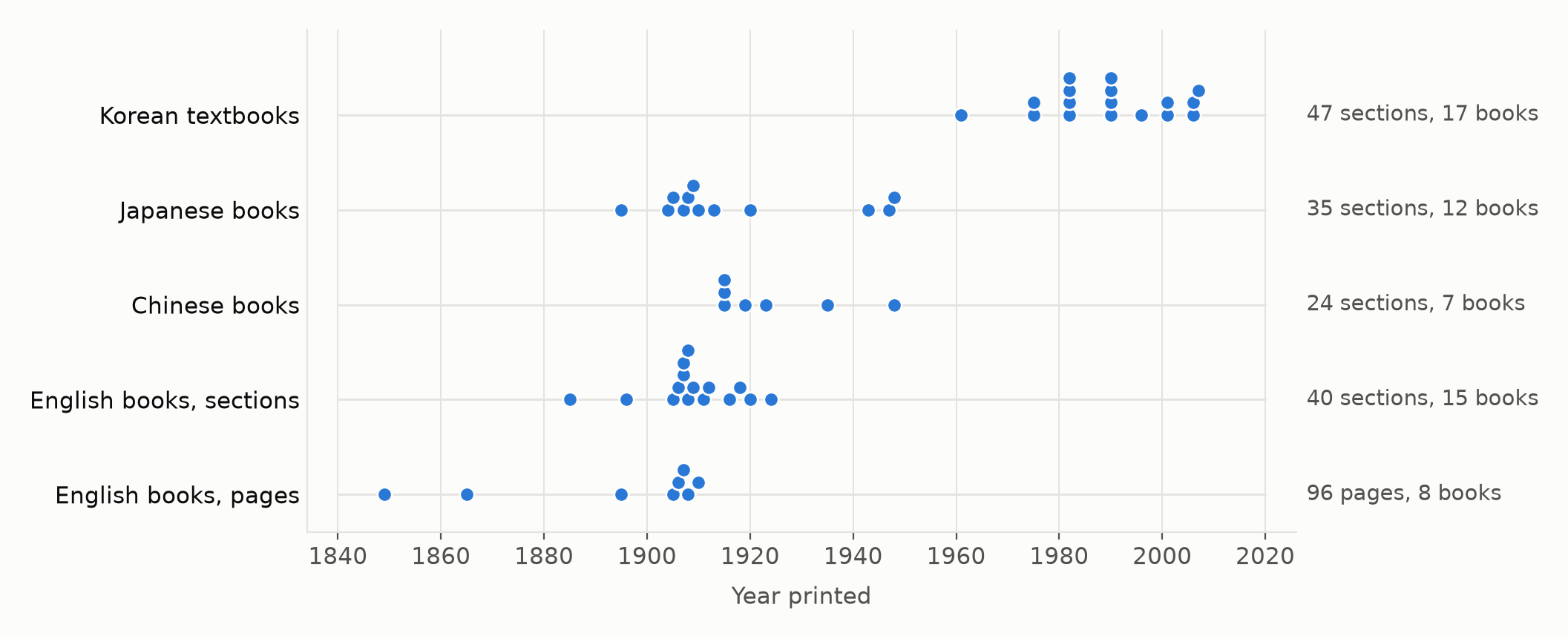
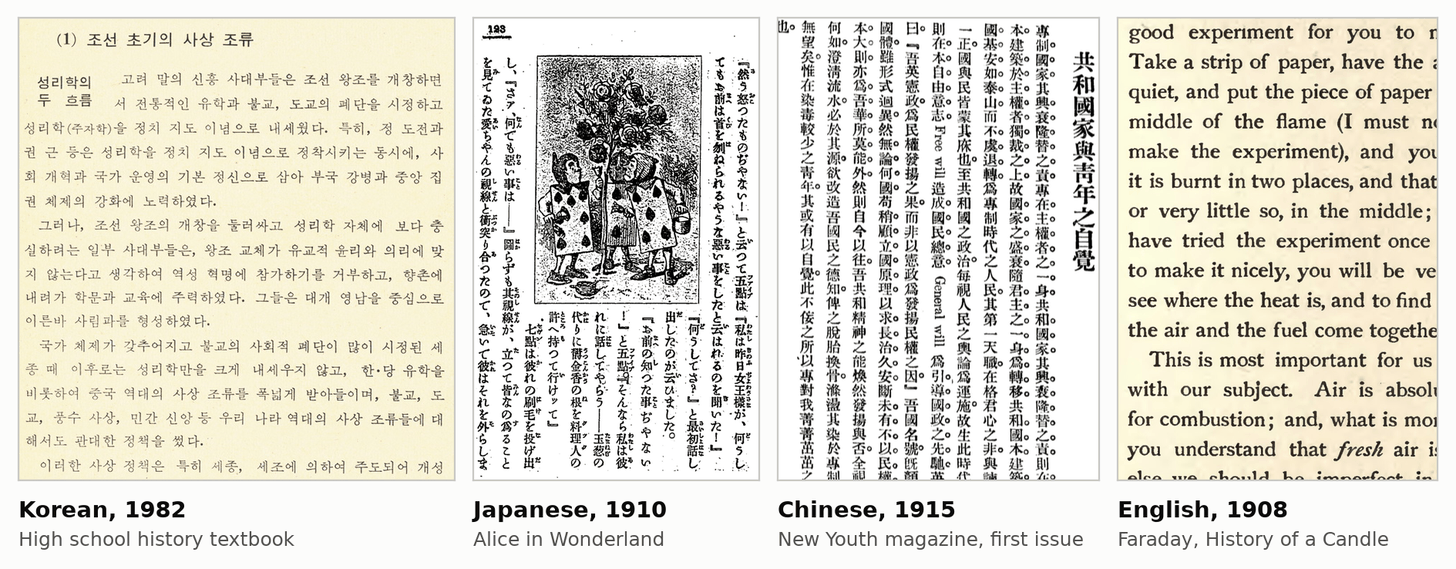
I constructed the benchmark for the Korean corpus by using text of previous state textbooks published online by the National Institute of Korean History (NIKH), and matched this against scanned images of the same textbooks (in the same editions) from the Georg Eckert Institute. These are 17 history and social studies textbooks for elementary, middle and high school (printed between 1961 and 2007). These books are set horizontally and, in some cases, have Chinese characters (hanja) interspersed among the Korean. Due to the fact that they were scanned for research purposes, I am unable to duplicate page images from these scans. The Korean page in Figure 1 comes from NIKH's own scan of the same textbook.
For the other languages I matched scans with human-produced transcriptions, which I collected from Project Gutenberg, Wikisource, and Aozora Bunko. The Japanese set has twelve books printed between 1895 and 1948, among them translations of Alice in Wonderland and of Bushido and two school textbooks. The Chinese set has three early issues of the magazine New Youth, a volume of Lu Xun's works, a literacy primer and two travel books, printed between 1915 and 1948. Nearly all of these pages are set vertically. The English books are school histories, readers and science primers. The two English sets are there for comparison. All 59 books are listed here, with links to the scans and the transcriptions and with three worked examples.
The score is character accuracy, or the proportion of characters that the model correctly reproduced from the reference text. If the model produced a text where 950 of the 1,000 characters in the reference text are correct, its score would be 95%. The field typically reports the character error rate (CER), the number of insertions, deletions and substitutions necessary to transform the model's text into the reference text, divided by the length of the reference text. My score resembles 1 minus this rate, except that (1) it is not dependent on the order in which a model writes out a page's components and (2) most text that a model inserts incurs no cost. I use it because the reference passages cover only part of the scanned pages, and CER would count everything else on those pages as errors. Flexible character accuracy is a related measure that also does not depend on the order.
The calculation is performed in three steps by a script. First, the model text is divided into individual sentences. Then each sentence is looked up in the reference. If the sentence is at least 80% similar to some portion of the reference text (90% if the sentence is short) it counts. Otherwise the sentence is treated as not read. In a second step, the sentences that count are ordered as they appear in the reference. In a third step, the characters of the reference that are found in these sentences in the same order are counted. The count of characters is divided by the length of the reference, and spaces and punctuation are ignored. Thus, a skipped or misread character results in a lower score. The score of a set is obtained by averaging over its passages (or pages), which are weighted equally.
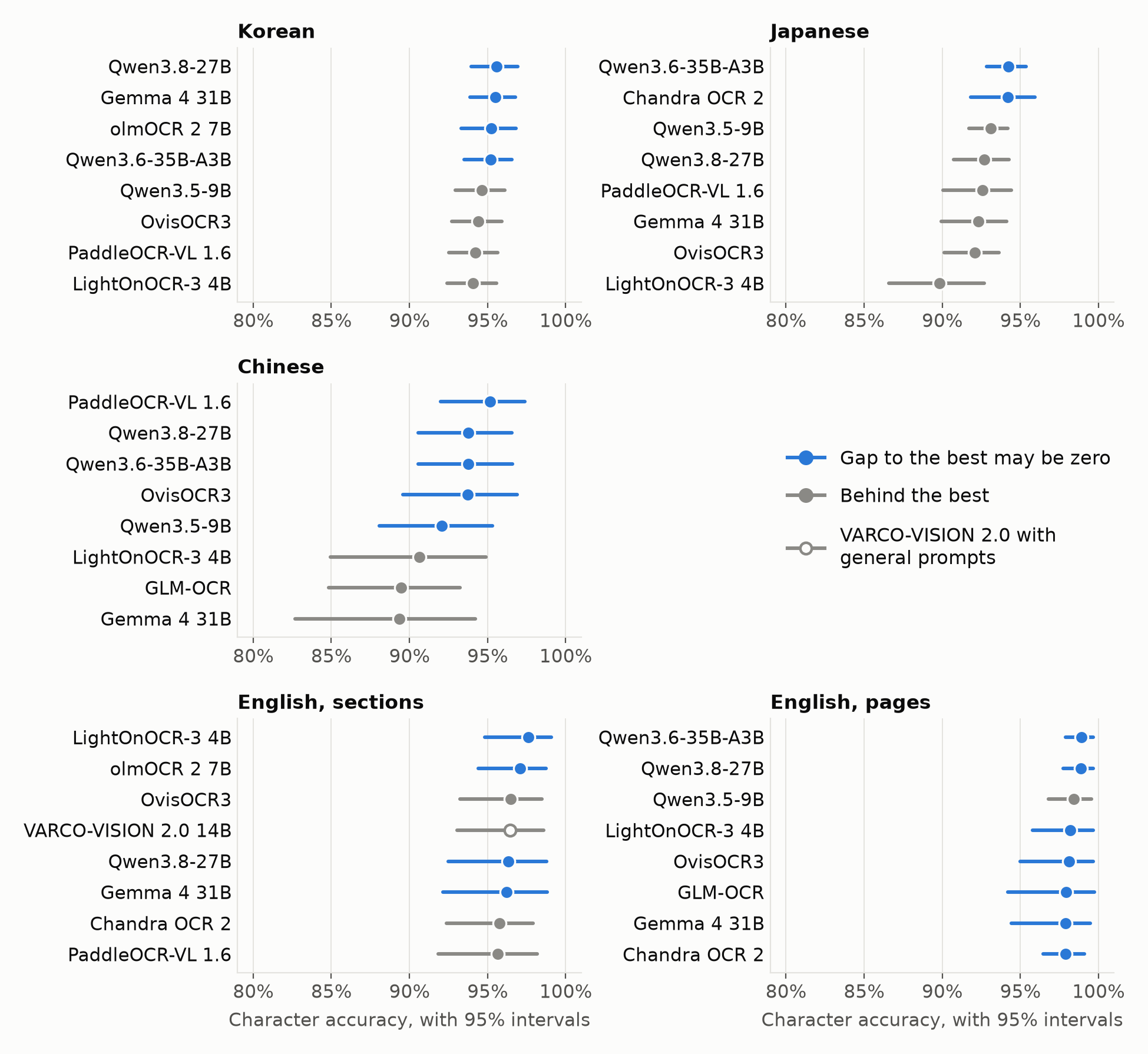
Since each set is relatively small (between seven and 17 books), a model's score will be partially determined by which books happen to be included in the set. The 95% intervals shown in Figure 5 indicate how much this matters. They are calculated using a bootstrap procedure. I repeatedly draw the same number of books with replacement (that is, allowing duplicates) from the books in the set. Hence, some books are drawn more than once, others not at all. In each drawn book, I then randomly draw the same number of passages with replacement, and again average the score. I repeat this process 2,000 times, and the interval is the range within which the middle 95% of these average scores fall. No page is ever reread.
To compare two models, I take the difference of the two in each of the 2,000 draws (using the same draws for both) and then look at the middle 95% of those differences. If this range of differences includes zero, the two models cannot be distinguished by these books. The intervals cover the choice of books and passages within a set and not the degree to which a model's score would vary upon reading the same pages for a second time.
There are two smaller checks as well. One does not require any reference. It checks whether the model's output is looping, whether it terminated at the output limit, whether it is blank, and assigns a score to the extent to which the output that remains resembles genuine text. The second check identifies all sequences of four characters in the reference text, and then tallies up the number of such sequences that are present in the model text (without lining up sentences).
What I found
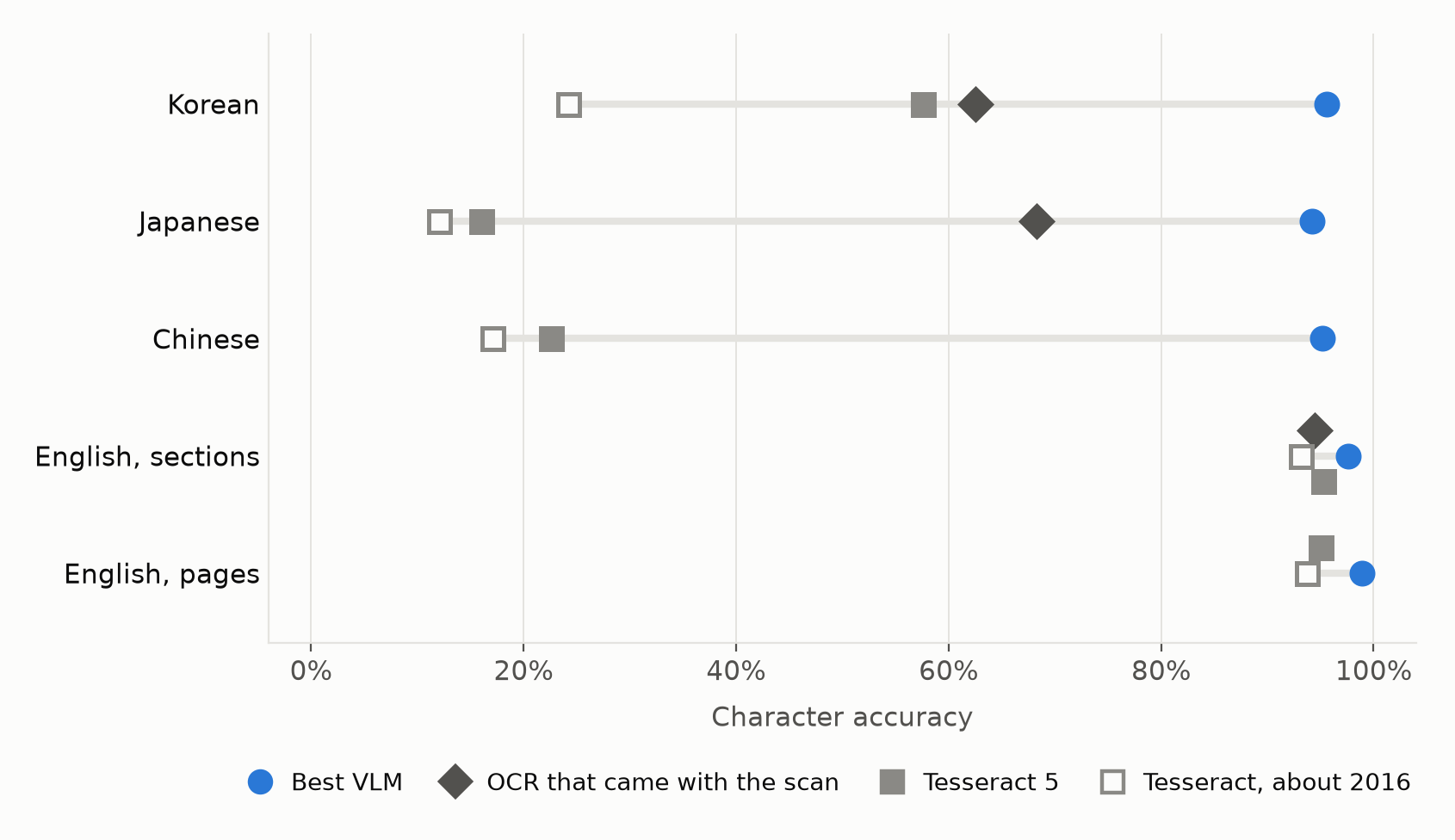
The best model reads substantially better than Tesseract (in both its versions) on the Chinese, Japanese, and Korean sets. The Tesseract engine of about 2016 can only read 12–24% of the text in these three languages. Even the current version, Tesseract 5, can only read 16% of the Japanese text, 23% of the Chinese and 58% of the Korean. In each of the three, the top-performing VLM can read 94–96%. The median model reads 94% of the Korean, 91% of the Japanese and 89% of the Chinese. On the English sets, where the 2016 engine is already able to read 93–94%, the best model reads only marginally better.
The OCR text provided with the scans falls in between at 62% (Korean textbooks) and 68% (Japanese books). The Japanese text is the one LINE made for the National Diet Library. Apart from the furigana, that OCR does about as well as the best VLM on the books I could compare.
I observe separation of models for the three non-Latin sets but clustering for English. All 14 of the models score between 89% and 99% on the English sets, but only ten pass 90% on the Korean, seven on the Japanese and six on the Chinese, and five score less than 65% in one or more of the three languages. GLM-OCR, when run on the software provided by its creators, scores 95% on the English sections but just 61% on the Korean (the lowest score among the 14 models). Gemma 4 E4B scores 95% on the English sections but just 41% on the Chinese. A high English score does not guarantee a high score in another language.
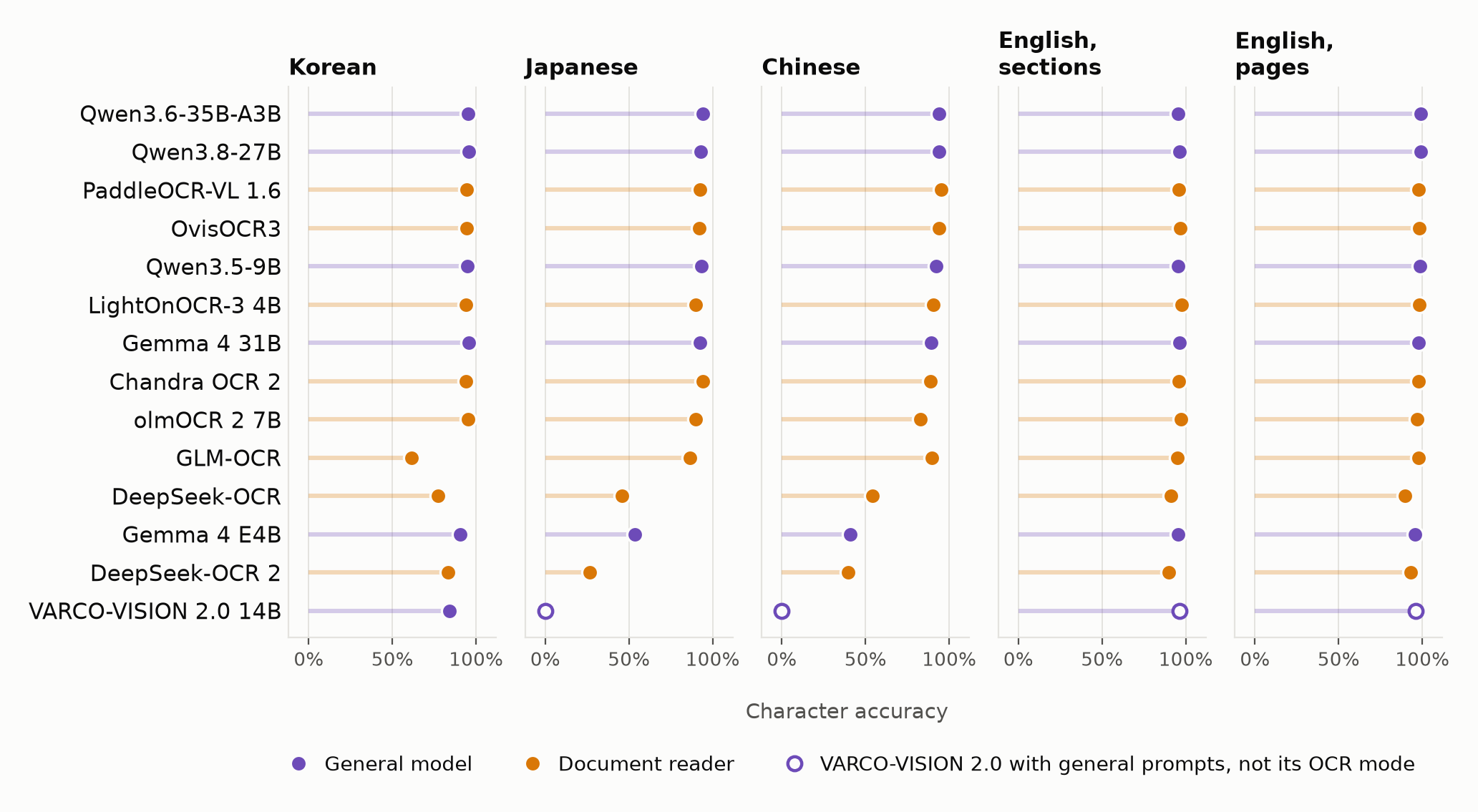
Among the leaders, the performance is very similar. Four of the models perform in the 95.2–95.6% range on Korean. The top model is language dependent, but Qwen3.6-35B-A3B never drops below 93% on any dataset. OvisOCR3, despite having only 0.8B parameters, is above 92% on all five. Neither kind of model wins overall. A general model leads on Korean and the English pages, a document reader on Chinese and the English sections, and on Japanese one of each ties.
The reference indicates what type of mistakes are made by the models. The model may miss text, or may locate the text but produce incorrect characters in some of it. The top model on the Korean dataset missed 3.9% of the text, and for that which it did locate it disagreed with the reference in 1.4% of the characters. The corresponding statistics for the Chinese top model are comparable at 3.8% and 1.6%, respectively.
On the Japanese set, things are reversed. For the best model, 2.7% of the text was missed and 5.4% of the characters that were found differed from the reference. Not every such difference counts as a misreading, however. For three of the leading models, more than half of the 14 most common substitutions are alternative forms of the same character (國 and 国) or large and small versions of the same kana. And, for every set, the second number is also a bit low, since a sentence containing many errors is considered a sentence missed.
Fluent output can still be wrong, and VARCO-VISION 2.0 shows how. With my general prompts, this Korean model scores zero in Japanese and Chinese. On 47% of the Japanese pages (counting the ten books it finished) it loops, never stops or returns nothing, which a simple check catches. On the remainder it generates sentences that do not appear on the page, and the check, which simply tests whether the generated text resembles genuine text, scores those pages 0.959 out of 1, versus 0.987 for Qwen3.6. The model also has an OCR mode, which its makers document for Korean and English. My run of it stopped at its time limit after finishing the Korean set, where it raised the score from 73% to 84%, so my general prompts understate the model there. The zeros in Japanese and Chinese are from the general prompts.
The two English sets do not always agree on the relative positions of models (the rank correlation between the two is only 0.31). For example, in the single pages Qwen3.6-35B-A3B takes first position (98.9%) while on sections it comes in 11th (95.3%), largely because on 11 pages it kept writing until it hit its output limit. Note, however, that many of these differences fall within the margin of error, so neither order should be interpreted too seriously.
What I would use
Korean textbooks: Qwen3.6-35B-A3B, which I already use. Qwen3.8-27B, Gemma 4 31B and olmOCR 2 7B score about the same.
Japanese books: Qwen3.6-35B-A3B or Chandra OCR 2, which score the same (check Chandra's license for commercial work).
Chinese books: PaddleOCR-VL 1.6, which scored highest. Qwen3.8-27B, Qwen3.6-35B-A3B and OvisOCR3 are within 1.5 points.
English books: LightOnOCR-3 4B, which is within a point of the best on both English sets. Qwen3.8-27B and OvisOCR3 are within 1.5 points on both. Tesseract 5 is two to four points behind and needs no GPU.
For several languages with one model, I would use Qwen3.6-35B-A3B on a 48 GB GPU, with a check for pages where it does not stop. OvisOCR3 fits a smaller GPU. I would avoid both versions of DeepSeek-OCR outside English, as I ran them, GLM-OCR for Korean, and Gemma 4 E4B for Japanese and Chinese. Whichever model you choose, transcribe some of your own pages first and score it on them.
How I ran it
My script sends an image of each page in the scan to the model (at 200 dpi resolution, unless the model developers specify another resolution), typically along with a prompt. The model outputs the text corresponding to that page. In cases where the page text terminates mid-loop or is truncated due to the output limit, my script forwards the same page image again, this time including a repetition penalty. A second script then compares the resulting text to the reference. All models ran on the Leiden University computing cluster, ALICE. Each model ran on a single GPU with 24, 48 or 80 GB of memory. Model weights were deployed using vLLM, an open source inference server. Tesseract ran on CPUs.
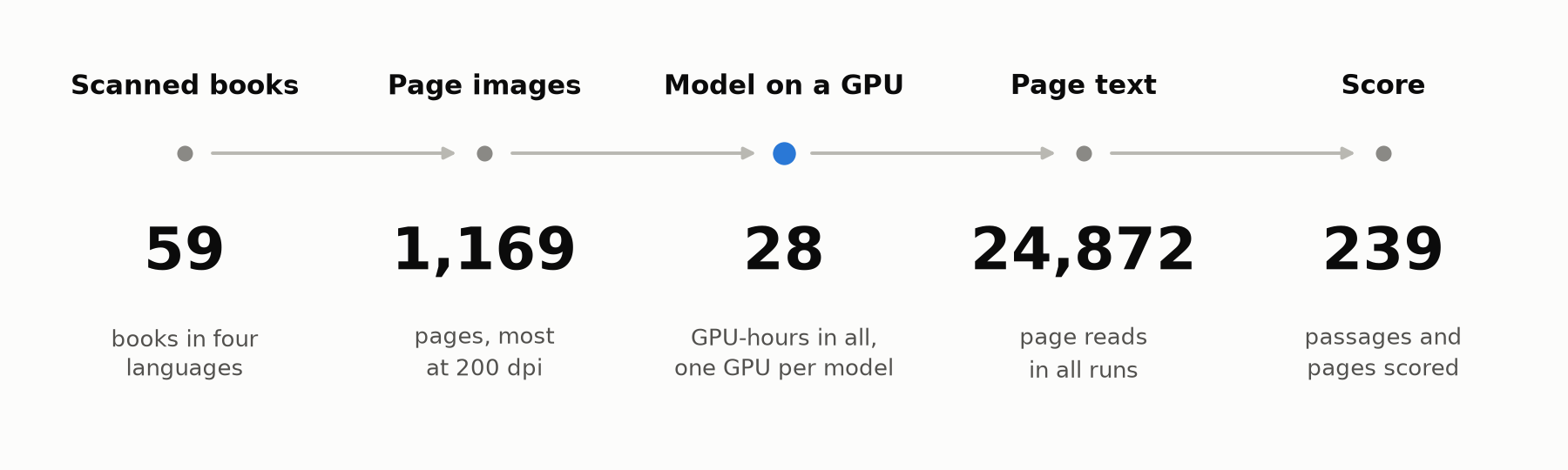
All the runs behind this post add up to about 25,000 page reads. A first pass over the 1,169 pages took 13 of the 14 models between 13 minutes and two hours, and VARCO-VISION 2.0 about eight hours.1 Over all runs, the first passes come to 28 GPU-hours, nearly half of them for VARCO-VISION 2.0. On one 48 GB GPU, Qwen3.6-35B-A3B read all 1,169 pages in half an hour, second attempts included, plus eight minutes to load the model.
The scores are for each model (including their setups). General models were given my detailed prompts. The OCR models were given their developers' prompts. PaddleOCR-VL and GLM-OCR were run via their makers' software. Following a review of the initial output, I adjusted the DeepSeek-OCR prompt. I also turned off its loop-blocking feature, treating loops exactly as I did for all other models. Even when it did not loop or get cut off on Chinese, Japanese and Korean passages, it performed worse than the median model. VARCO-VISION 2.0's Korean score uses its OCR mode. Its other scores use my general prompts and are tentative.
Thus far, I have evaluated five different settings (two prompts for Chandra, vertical mode for Tesseract, the layout step for GLM-OCR, the OCR mode for VARCO and, in the case of Qwen3.6, the sequence in which the image and the text were presented). None of these influenced my recommendations. GLM-OCR's layout step lowered its Japanese score by three points. Its software also breaks apart paragraphs. I rejoined them after the first score, which raised its Korean score from 58% to 61%. DeepSeek-OCR and Tesseract also break up lines, and I could not rejoin theirs. On a count that ignores line breaks, both remain well behind the best models.
What to keep in mind
Some of the tested texts are openly available online, and some are famous texts, so models could have been trained on them and may be recalling them. I have not tested this. The texts also differ in more than just their script. The Korean books are newer, and most of the Japanese and Chinese books are set vertically. A gap in performance between two languages does not need to be a script-effect alone. I tested three East Asian scripts in old print. The results may not carry over to other non-Latin scripts, such as Arabic.
The Korean set leans toward Qwen3.6, because I used its text to find each passage on the scans and tuned the prompt on it. The Japanese passages from five books were located with the library's own OCR, which may favor it. I have not yet tested NDLOCR, the open-source program of the National Diet Library.
I dropped three passages, two of them in English and one in Korean, because none of the systems reproduced 80% of the reference. In two cases the best systems all level off at around the same proportion, indicating a possible mismatch between the scan and the reference. The third is a series of genealogical tables, the best system reproducing 67%. If they were included, the best Korean score would be 95.1% instead of 95.6%, and the best score on the English sections would be 95.4% instead of 97.6%. I ran each model once, with the exception of Qwen3.6, for which a second run yielded a difference of just 0.2 percentage points in the Korean average.
I will publish updates to this benchmark as new models come out, and as I test the current ones further, including how much their training data (i.e., what is already “in the weights”) influences their output.
I do not compare speed, because my timings are not like-for-like. The smaller models ran on a 24 GB GPU and the larger ones on 48 GB or 80 GB GPUs. PaddleOCR-VL read one page at a time, where most of the others read 32.